
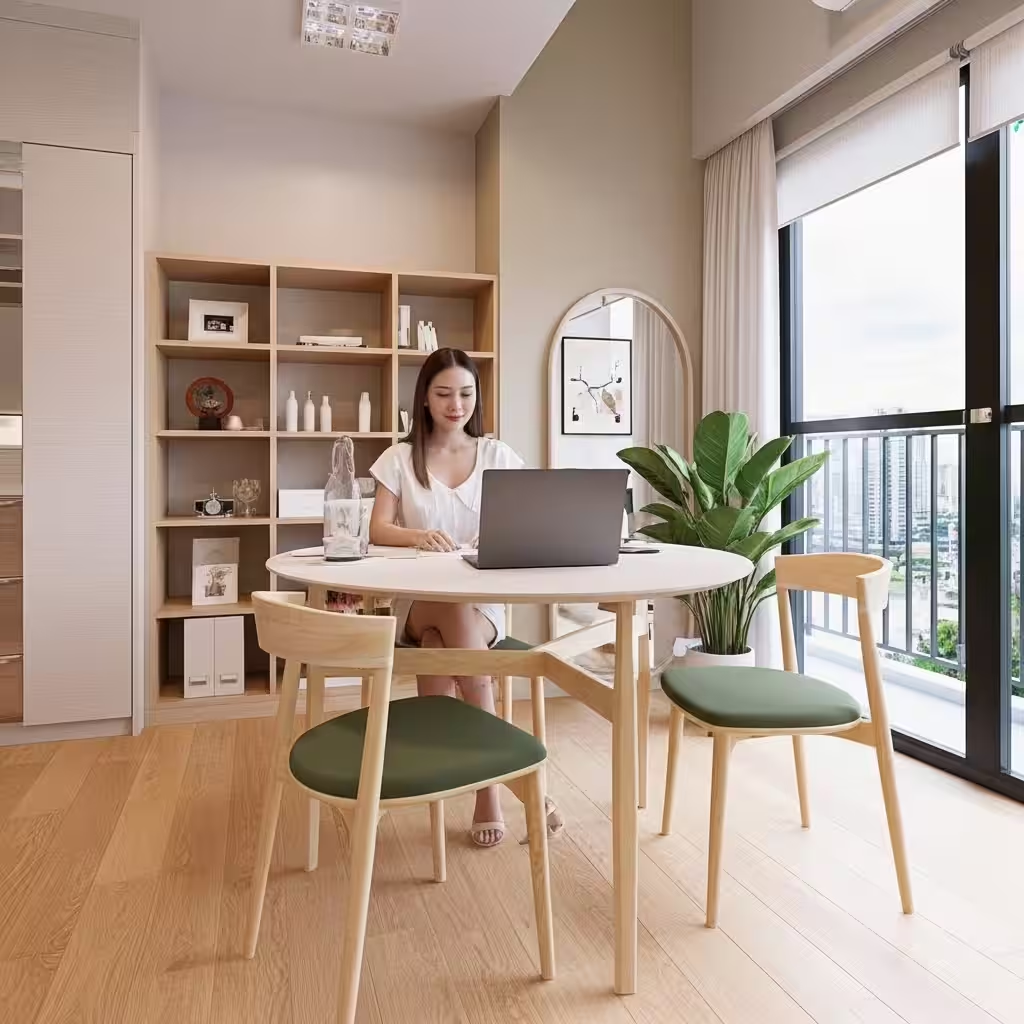
If your current studio unit feels tight and limiting, the problem may not be the size — it may be the layout. Here’s how vertical design can transform compact living into a functional, flexible, and future-ready space without dramatically increasing your budget.
The Real Problem With “Small” Units
In many parts of Metro Manila, studio units range from 18 to 24 square meters. On paper, that may seem manageable. But once you move in a bed, a small sofa, a dining table, and storage, the space quickly feels crowded.
The issue is not just square meters.
It is how the space is distributed.
When everything happens on a single flat plane — sleeping, working, dining, storage — visual clutter builds up. Productivity drops. Relaxation becomes difficult. Even couples begin to feel the pressure of limited personal zones.
Some renters attempt to solve this by renting external storage for PHP 2,000 to PHP 4,000 per month. Others upgrade to a one-bedroom unit, which can mean an additional PHP 8,000 to PHP 15,000 in monthly amortization or rent.
But what if the smarter solution is not moving outward — but upward?
Why Vertical Space Is Often Wasted
Most traditional studio units have standard ceiling heights that leave unused air space above. That vertical volume serves no function.
However, when ceiling height is intentionally engineered, it creates an opportunity to build upward without increasing the building footprint. This is where vertical design changes the experience of small-space living.
Instead of squeezing everything into one floor, you separate functions:
- Sleep above.
- Work or lounge below.
- Store efficiently without crowding sightlines.
The result is not just more usable area — it is psychological spaciousness.
The Financial Advantage of Vertical Efficiency
Let us look at a simplified example.
A typical 24 sqm studio priced at PHP 6,000,000 places you at PHP 250,000 per sqm.
Now imagine a 23.56 sqm unit engineered with an additional 9.37 sqm loft, creating 32.93 sqm of total usable space. If priced competitively within the same market range, the effective cost per usable square meter drops significantly.
Instead of paying for a larger flat unit, you gain functional expansion within the same footprint.
That difference improves long-term value and flexibility.
How Flexible Space Supports Real Life
Small units feel restrictive when life evolves.
You may start as a single professional working hybrid. Later, you might:
- Transition to full remote work.
- Move in with a partner.
- Start a small family.
- Need space for a side business.
Without vertical separation, these transitions often force relocation — triggering new loan processing fees, moving costs, and renovation expenses.
A well-designed lofted layout allows the same unit to adapt. The upper level can function as a sleeping area, private office, creative studio, or additional storage, depending on your life stage.
A Practical Example in Pasig
Lykke Kondo in Pasig integrates PH1 Add-Loft technology across its unit types. For example:
- Studio: 23.56 sqm + 9.37 sqm loft = 32.93 sqm usable
- 1BR: 38.19 sqm + 14.20 sqm loft = 52.39 sqm usable
- 2BR: 60.94 sqm + 21.51 sqm loft = 82.45 sqm usable
This approach converts engineered ceiling height into functional living space at no additional cost per added loft area.
Located 120 meters from Ayala Malls Feliz, the development combines vertical efficiency with proximity to daily essentials, reducing the need to compensate for small interiors by spending more time outside.
Small Does Not Have to Mean Limiting
The true measure of a home is not only its size.
It is how intelligently the space works for you.
When vertical design is intentional, a studio can function like a compact one-bedroom. A one-bedroom can adapt like a flexible two-level home.
Instead of upgrading purely for additional square meters, consider whether smarter design can achieve the same outcome.
Because sometimes, the smartest way to expand your life is not by buying bigger — but by building upward.
Subscribe to receive updates and request a sample computation for Lykke Kondo.
Reviewing a sample computation can help you understand the estimated down payment, projected monthly amortization, and available payment structures. It provides a clearer picture of the financial commitment involved and allows you to assess how it fits within your current budget and long-term plans.
Whether you are exploring your first property, considering an upgrade, or evaluating an investment option, having the figures in front of you supports a more informed decision.
If you would like the latest computation based on your preferred unit and payment terms, you may subscribe to receive the details.